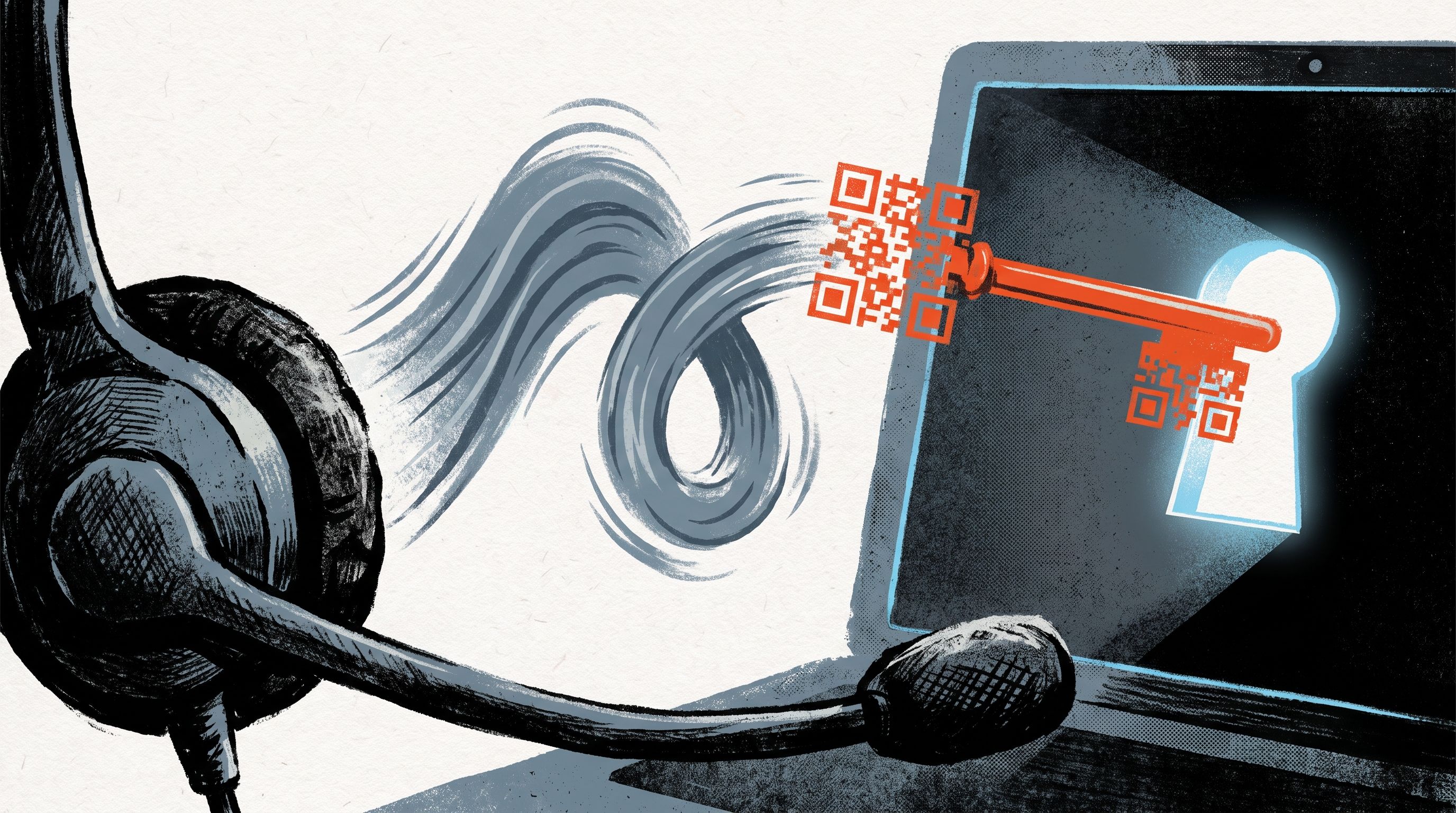
Vishing is phishing by phone call, quishing is phishing through a QR code, and AI phishing is any of the above written or voiced by a model. Together they are the phishing trends that defined 2026, and they share one move that matters more than the channel. They pull the victim off the laptop your controls watch and onto a phone, where the attacker can collect a password and an MFA code and simply log in.
CrowdStrike’s 2026 Threat Hunting Report has the number that frames this post. Snarky Spider, one of two crews it watched using vishing to take over single sign-on accounts, went from account takeover to data theft in under five minutes in one intrusion. No exploit was needed, and no email gateway ever sees a phone call. Hold on to those five minutes, because every control in this post has to work inside them.
Phishing trends in 2026: the inbox is no longer the front door
The incident data moved first. In Mandiant’s M-Trends 2026, built on 2025 investigations, voice phishing rose to 11 percent of initial infection vectors and became the second most common one, behind exploits at 32 percent. Email phishing fell from 14 percent in 2024 to 6 percent.
Email has not gone quiet. Microsoft still counted about 8.3 billion email phishing threats in the first quarter of 2026. What changed is where the successful ones land. Verizon’s DBIR team notes that people are often more likely to fall for a mobile threat such as a text or a scam call than for a traditional email.
What is a vishing attack, and why help desks are the target
A vishing attack in 2026 is rarely a stranger asking for a bank PIN. Mandiant describes financially motivated groups targeting IT help desks with voice phishing, impersonating employees to get initial SaaS access. CrowdStrike saw vishing intrusions double in the first half of 2026 compared with the second half of 2025. In cloud compromises the order flips entirely, with voice phishing the most common vector at 23 percent, ahead of third-party compromise and stolen credentials.
The mechanics explain the speed. CrowdStrike told VentureBeat that the most active attacker in financial services, a group it calls Mutant Spider, calls employees over Microsoft Teams posing as IT support, talks them into an MFA reset and registers its own device. Its Adam Meyers asked who needs a zero-day “if all you have to do is call the help desk” and claim a forgotten password. If the voice itself is cloned from an executive, the same verification failures apply, and we covered those cases in our deepfake social engineering guide.
AI vishing changes the economics before it changes the voice
The newest research on AI vishing is less about uncanny voices than about cost. A team led by Fred Heiding exposed 4,100 US adults to AI-generated scam calls, as audio or transcripts, from six voice models alongside human baselines. Across five scam types, 16.5 percent said they would or might comply, rising to 36 percent for the relative-in-distress script, and one model was rated as persuasive as a human caller or slightly more. Their economic analysis is the part we would put in front of a CFO, because human-operated vishing is unprofitable at US wages while AI-powered vishing appears viable for several models. Scale, in other words, is now cheap.
What is quishing? QR code phishing moves the click to the phone
Quishing hides the phishing link inside a QR code, so the text scanners in your mail stack see an image and the victim opens the link on a phone. Microsoft watched QR code phishing grow from 7.6 million attacks in January 2026 to 18.7 million in March, a 146 percent rise and its highest monthly volume in at least a year. Most arrived inside PDFs, while codes placed directly in the email body jumped 336 percent in March. ESET found malicious QR codes in at least 11 percent of all phishing email in the first half of 2026.
| Period | Value |
|---|---|
| Jan 2026 | 7.6M |
| Mar 2026 | 18.7M |
The FBI’s January 2026 warning about North Korea’s Kimsuky group shows where quishing ends. Its flash alert says these operations frequently end with session token theft and replay, which bypasses MFA without a failed-MFA alert, and that the compromise path runs on unmanaged phones outside EDR and network inspection. A review of 27 quishing studies published in August 2026 explains why people scan anyway, pointing to contextual legitimacy, routine scanning and limited destination visibility. A QR code in a plausible document looks like part of the document.
AI phishing attacks: better lures, not yet better results
Large language models have clearly made phishing emails better. In a 101-person study by Heiding, Bruce Schneier and colleagues, fully AI-automated spear phishing earned a 54 percent click-through rate, the same as emails written by human experts and far above the 12 percent control group. The AI built accurate target profiles in 88 percent of cases, which is the reconnaissance step attackers used to pay for.
Volume followed. Verizon’s 2026 DBIR, drawing on data from Anthropic, found AI-assisted text in malicious emails had doubled, and phishing made up 44 percent of the AI-assisted initial access vectors it identified. Yet the same report says the increase has not shown up as a measurable rise in phishing success in its breach data. We read that as good news with an expiry date. Fluent lures removed the spelling-mistake tell that awareness training leaned on, and the controls that will hold are the ones that never depended on a human spotting bad grammar.
Mitigation: how to prevent vishing, quishing and AI phishing
Back to those five minutes. Nobody in a SOC triages a ticket that fast. The controls that matter either remove what the caller wants to collect, or turn the attacker’s first move, enrolling their own MFA device, into an alert that fires on its own.
Start with authentication, because all three trends end at a login page. CISA calls FIDO and WebAuthn the only widely available phishing-resistant MFA, and moving privileged users and help desk staff there first removes the codes a caller or a fake page can collect. Then treat MFA enrollment as a security event. Alert on every new device registration and every MFA reset, and route resets requested by phone through a callback to a number already on file plus a manager’s approval. Mandiant now tells organizations to train help desk staff to recognize unauthorized MFA reset requests, and a written rule makes that training enforceable.
Close the side doors next. Microsoft advises getting as close as possible to a unilateral block on device code flow, and CrowdStrike saw device code phishing attempts rise 15 times in the first half of 2026. For quishing, make sure your mail filtering decodes QR codes inside images and PDFs, and bring the phones that scan them into scope for your mobile security policy. This identity hardening is the core of our security engineering work.
Frequently asked questions
What is vishing?
Vishing is voice phishing, a phone call in which the attacker impersonates a trusted party to get credentials, MFA codes or a payment. In 2026 the common business version targets IT help desks and employees with fake support calls, and Mandiant ranks it the second most common initial infection vector.
What is quishing?
Quishing is QR code phishing. The malicious link sits inside a QR code in an email, a PDF or a printed notice, so text-based filters miss it and the victim opens it on a phone, often outside corporate security tools.
What is the difference between vishing and phishing?
Phishing is the umbrella term, usually meaning email lures. Vishing is phishing by phone call. The difference matters because a live caller adapts to objections in real time, and email filters never see the conversation.
How do you prevent vishing?
Never let a phone call alone justify an MFA reset or a new device. Verify by calling back a number already on file, require a second approver for resets, alert on new MFA device registrations, and move staff to phishing-resistant MFA so there is no code to read out.
Bottom line
Move privileged users and the help desk to FIDO2 or passkeys, alert on every new MFA device, and block device code flow wherever nobody uses it. Then decode QR codes at the mail gateway and stop assuming a fluent email is a safe one.