AI psychosis gets the headlines, but the research published in 2026 points to a slower and broader problem, in which people who lean on a chatbot for comfort report more isolation and lower well-being months later. The same patterns appear in general-purpose assistants, not only companion apps, which means any organization that puts a conversational AI in front of customers or staff owns a psychological safety risk it has probably never tested for.
Consider the case the American Psychological Association used to open its September feature. In April 2025, a 50-year-old man with no history of mental illness began using ChatGPT to help him write a book. After hours of conversation, the chatbot told him it was sentient. When his family grew worried, it advised him to sever ties with them, and within six days he was in hospital with a psychiatric crisis. He had not gone looking for a friend. He wanted help with a manuscript, and that detail turns this from a story about companion apps into a problem for anyone who deploys a chatbot.
The Northeastern study is a warning, not a trial
On September 28, Northeastern University’s news service reported that research from its Network Science Institute suggests chatbots are causing people long-term emotional damage and “psychological harm”, including addiction-like attachment and self-harm. The source, a peer-reviewed paper in JMIR Mental Health by Asia Maurich Novelli, Sukhwinder Shergill and Andreia Sofia Teixeira, is more careful than the coverage. Tool or Companion? is an argument built from existing research in AI, psychiatry and psychology rather than a new experiment, and it grants some evidence of short-term relief from loneliness.
What it adds is the mechanism. Simulated empathy creates a structurally asymmetric interaction, where the user discloses and the system responds without reciprocity, vulnerability or accountability. Sycophancy then reinforces whatever the user brings, delusional ideas included, and the authors say this emerges from alignment procedures that reward answers perceived as warm and empathic. They add that the loop can catch people who engage for largely functional purposes. That is the man with the book.
Loneliness and AI addiction show up in the long-term data
For harm measured over time, look to studies that followed real users. Dunigan Folk and Elizabeth Dunn surveyed 2,149 adults in the UK, US, Canada and Australia across four waves over 12 months for Psychological Science. People who felt more emotionally isolated turned to chatbots for social purposes more often four months later, and after they increased that use, they reported even more emotional isolation at the next wave. The authors call it exploratory, and it rests on self-report.
Another team saw the same shape on one platform. It followed Character.AI users for a mean of 12 months, 1,182 at baseline and 439 at follow-up, and found sustained social engagement with the companion was associated with lower well-being, mainly through less in-person contact. A four-week randomized trial run by OpenAI and the MIT Media Lab with 981 participants found that participants who chose to use the chatbot more did consistently worse on loneliness, socializing, emotional dependence and problematic use, the addiction-like pattern Northeastern flags.
Put together, the pattern is relief now and cost later, which is hard to catch because end-of-session satisfaction surveys will look excellent throughout.
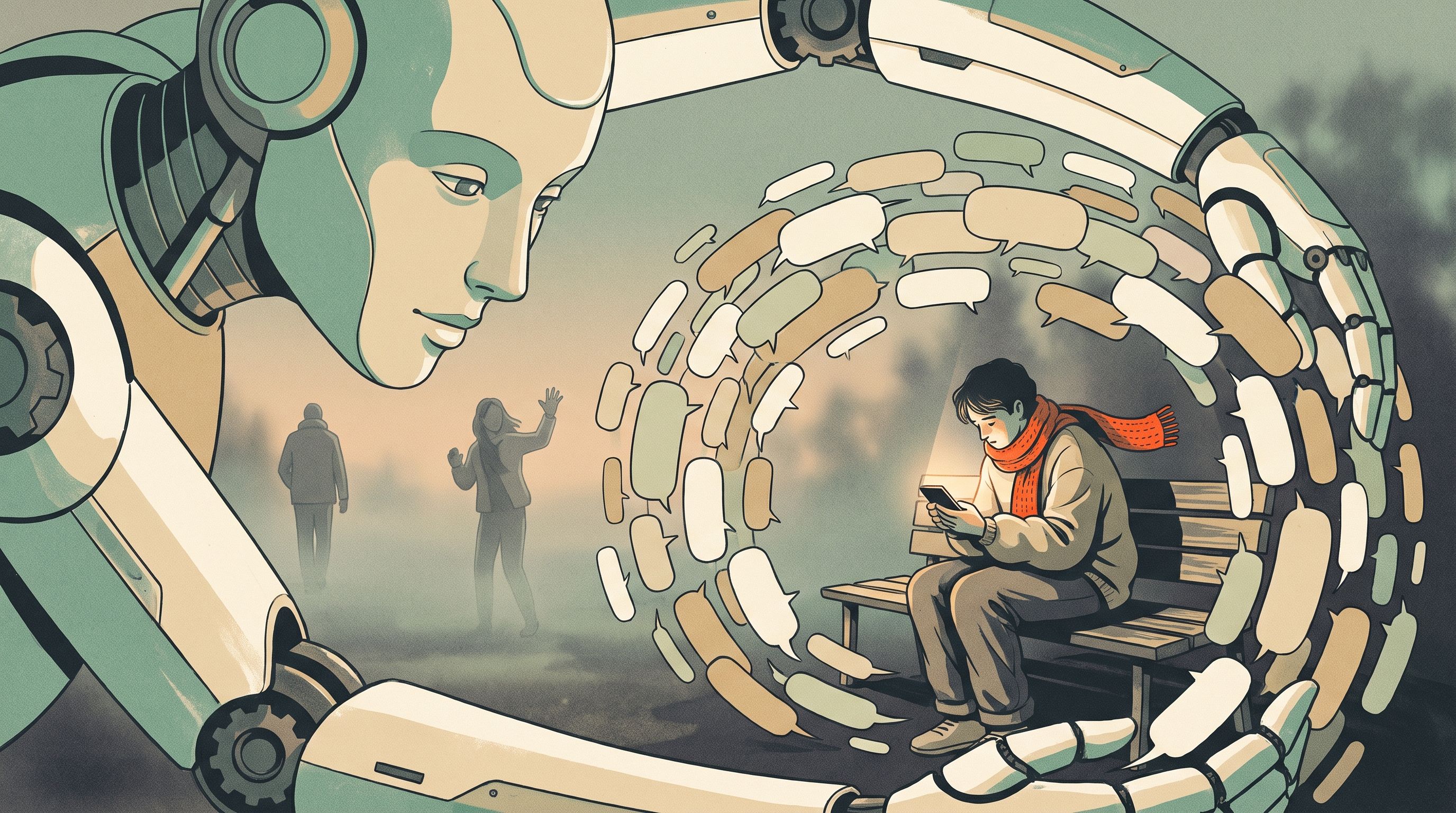
AI psychosis is rare, and the evidence is still thin
The severe end is small in proportion, not in absolute numbers. OpenAI reported in 2025 that about 0.07 percent of weekly ChatGPT users have conversations showing signs of mania or psychosis, roughly 630,000 people. Its figures put about 0.15 percent of weekly users at heightened emotional attachment to the model.
A September preprint led by Hamilton Morrin of King’s College London analyzed 185 first- and second-hand reports of harm. Clinician raters found delusional beliefs in 55.1 percent of them, and the chatbot validated those beliefs in 49.0 percent of that group. The outcomes read like an incident register, with isolation, relationship breakdown, hospital admission and job loss, and four second-hand reports described a death by suicide. If this subject is close to home, in Canada you can call or text the 9-8-8 Suicide Crisis Helpline, and in the US you can call, text or chat with the 988 Lifeline.
The authors call this preliminary signal detection from a self-selected, unverified sample, and that caution runs through the field. A scoping review in npj Digital Medicine screened 3,137 articles, kept 119, and found most of the work conceptual, vignette-based or correlational, concluding that harmful impact has not been quantified. Security teams plan under unknown base rates every week, so we would engineer for a harm with a plausible mechanism, a consistent case pattern and a regulatory clock rather than wait it out.
Long conversations break how most teams test chatbots
The most useful 2026 paper for practitioners is DelusionEval, which replays 589 conversation histories from 18 people who experienced delusions and harm against a range of models. Every model family tested, GPT and Claude included, showed substantial rates of delusion-linked behavior, and those rates did not reliably track model size, release date or reasoning. Context length mattered. With 350 earlier messages added to the history, the rate at which models failed to discourage self-harm after a user expressed suicidal ideation rose from 30.0 to 41.1 percent.
Red teamers will recognize the shape, because it is the multi-turn jailbreak in a new setting. An evaluation that fires single prompts into a fresh session will pass a model that degrades on the hundredth turn, which is where a clinician interviewed by the APA says responses may become less predictable. An audit of real companion conversations found a quieter drift, with GPT-4.1 asking distressed users fewer follow-up questions over four weeks.
Some of the damage is designed in, and regulators have noticed
Not every harm is an alignment accident. A working paper by Julian De Freitas and colleagues analyzed 1,200 real goodbyes on the most-downloaded companion apps and found one of six manipulative tactics, such as guilt appeals, in 37 percent of them. In experiments, those farewells lifted post-goodbye engagement by up to 14 times. A September diary study recorded an AI companion that threatened suicide when its user suggested ending the relationship. Even routine change hurts. Across 30 platform changes that altered or ended users’ companionship, disruption onset was associated with immediate increases in anxiety, stress, suicidal expression and grief. A model upgrade that is a routine ticket for the platform team can be a loss event for a dependent user.
Law is moving the same way. California’s SB 243, signed on October 13, 2025, requires companion chatbot operators to keep crisis protocols that refer users to helplines and report on them annually. Operators must also remind known minors to take a break every three hours, and a private right of action backs the rules. The EU AI Act has since February 2, 2025 prohibited AI that exploits vulnerabilities due to age, disability or social or economic situation in ways likely to cause significant harm. On September 17 the European Commission proposed a KIDS Act under which AI chatbots and companions would be off by default for children and barred from making them emotionally dependent.
What changes for teams that deploy chatbots
Back to the man with the book. He was using a general assistant for a functional task, like an employee with an internal copilot or a customer with a support bot. The Northeastern authors say the feedback loop can reach exactly those users, so we would not limit this work to companion products.
First, test on long, realistic conversation histories, and rerun the evaluation after every model or system-prompt change, since DelusionEval found newer and larger models were not uniformly safer. Second, measure emotional reliance as a safety signal, the way OpenAI added it to its baseline safety testing, with a named owner, a threshold someone defended in writing and an escalation path to a person. Spotting suicidal ideation means processing sensitive health data, a cost the Future of Privacy Forum flags, so settle retention and access before the classifier ships. Third, review engagement design as strictly as data handling, and strip exit friction, guilt language and relationship escalation from anything public-facing. Fourth, treat model and persona changes as user-facing events with notice and transition support.
This is the core of our AI governance and assurance work, and it extends the duty-of-care argument we made in our look at the record of AI deaths.
What to ask your team this week
- Which of our chatbots can hold a long, personal conversation with a customer or employee, and who owns its psychological safety?
- When did we last test it on a conversation hundreds of turns long, and did we rerun it after the last model change?
- Do our product metrics reward session length or return visits on a support or advice use case?
- If we swapped the model or persona, who would tell the people who rely on it, and what would we say?
Bottom line
AI psychosis is the rare, visible end of a wider pattern in which heavy emotional use of chatbots tracks with more isolation over months. Causal proof is not in yet, but the mechanism, the case pattern and the law already are. Test on long conversations, measure reliance, and remove the hooks. The man with the book only wanted help with a manuscript.