Deepfake social engineering is the use of AI-generated voice or video of a real person, usually an executive or a colleague, to push an employee into moving money, resetting credentials or granting access. It stopped being a novelty problem some time ago. In a Gartner survey of 297 security leaders run between March and May 2026, 41 percent of CISOs reported at least one deepfake incident on an employee audio call in the previous twelve months, and 36 percent reported one on a video call. If your controls still assume that a familiar voice or face proves identity, you are defending against an attacker who no longer exists.
The good news, and the reason we wrote this post, is that the incidents which failed all failed the same way. Not because someone spotted a visual glitch, but because a procedure refused to care how convincing the call was. That procedure is buildable in a week, and the second half of this article is the build.
Deepfake attack examples that actually happened
The reference case is still Arup. A finance employee in the firm’s Hong Kong office received a message from the company’s UK-based CFO about a confidential transaction, suspected phishing, and then joined a video call with the CFO and several colleagues. Hong Kong police described the case in February 2024: everyone else on that call was a deepfake, and believing they were real, the employee paid out HK$200 million, about US$25.6 million. Arup was later confirmed as the victim, the money leaving in 15 transactions to five local bank accounts. The employee’s initial doubt was correct. The call is what dissolved it, which is exactly the job a deepfake does.
The failed attempts teach more. In April 2024 an attacker sent a LastPass employee WhatsApp messages and deepfake audio of CEO Karim Toubba. The employee ignored it, not through audio forensics, but because a CEO request arriving over WhatsApp with forced urgency sat outside every normal channel the company uses. A month later, scammers cloned the voice of WPP’s CEO from public footage and set up a Teams meeting to solicit money from an agency leader. Also unsuccessful. In July 2024 a Ferrari executive got WhatsApp messages and then a live call that reproduced CEO Benedetto Vigna’s southern Italian accent, pitching a confidential acquisition. The executive asked which book Vigna had recommended days earlier. The caller hung up.
There is a fourth pattern that gets less attention because no wire transfer is involved. In July 2024 KnowBe4, a security awareness vendor, hired a North Korean operative who used a stolen US identity and an AI-modified photo to pass interviews. The company caught him because the corporate laptop started loading malware within minutes of delivery. By July 2026 this had grown into something eleven governments felt compelled to address jointly, warning that DPRK IT workers now use real-time deepfake video during live interviews, mapping a stolen or synthetic face onto the operative’s camera feed. The US Treasury put the scheme’s revenue near 800 million dollars in 2024 alone.
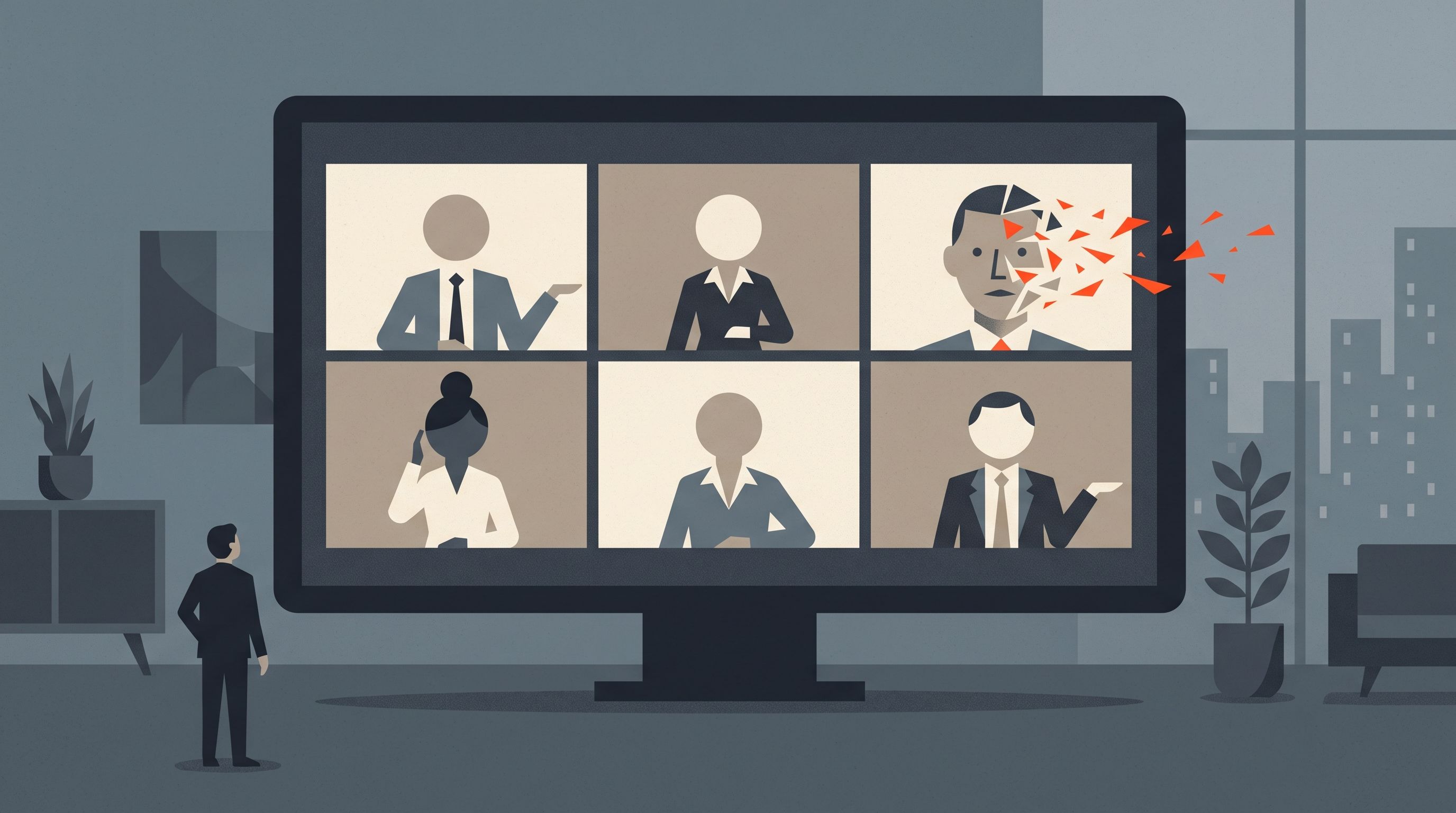
How a deepfake social engineering attack works
The mechanics are cheaper than most defenders assume. Speech synthesis research crossed the relevant line back in 2023, when Microsoft’s VALL-E showed convincing voice mimicry from a three second sample, and commercial tools have only lowered the bar since. For anyone your attacker would bother impersonating, hours of source material already sit in earnings calls, keynotes and podcasts. Video is harder but no longer hard, as the Arup call and the DPRK interview tooling both demonstrate.
The play itself is classic pretexting with a better mask, and it maps cleanly to ATT&CK T1656, impersonation. The attacker opens on a side channel, almost always WhatsApp or a personal number, claiming the official channels are unsuitable because the matter is confidential. An acquisition at Ferrari, a legal matter needing an NDA at WPP. Then the voice or the face arrives to collapse skepticism, and urgency plus secrecy squeeze out verification. Gartner’s survey names the three destinations we see too. The caller wants a payment authorized, an account recovered, or privileged access granted. Which means the deepfake is only the delivery mechanism, and the thing you defend is the transaction behind it.
Banks meet the same technology from a different angle. FinCEN’s alert FIN-2024-Alert004 of November 13, 2024 describes deepfake media used to defeat customer identity verification and due diligence at onboarding, and gives financial institutions the SAR key term FIN-2024-DEEPFAKEFRAUD for reporting it. If you run KYC, that alert’s red flag list is the fastest route into this problem for your fraud team.
How to spot a deepfake video call
Here is the honest answer. You mostly cannot, and building your control around perception is building on sand. The artifact-spotting advice from 2023, watch for odd blinking and mismatched lip sync, decays with every model generation, and the NSA, FBI and CISA guidance had already shifted the emphasis in September 2023 toward verification procedures and rehearsed response rather than trained eyeballs.
What actually held in the field is context and challenge. Every failed attempt above failed on one of three tripwires. The channel was wrong, WhatsApp instead of the corporate directory. The request pattern was wrong, urgency plus secrecy plus a bypass of normal approvals. Or a challenge question required knowledge the model could not have, like Ferrari’s book recommendation. Train people on those three, because they survive model improvements. Live liveness challenges, asking the caller to turn their head, wave a hand across the face or answer something private, still break most real-time video tooling today, but treat that as a bonus layer, not the control.
What shows up in your logs
We will be straight about the limits. The deepfake call itself usually happens on infrastructure you do not log, a phone line or a personal WhatsApp. Detection therefore means catching what the call causes inside your estate, and the highest-yield place to look is account recovery, because a helpdesk reset driven by a convincing voice is the cheapest thing a deepfake buys. That chain is T1598 voice phishing feeding T1078 valid accounts.
The sequence worth watching is a helpdesk-driven password or MFA reset followed within hours by a sign-in from a new device, location or risk level. Every step in that chain is routine on its own, and every identity provider already records each one in its audit and sign-in logs, so ask your SOC to treat the sequence, not the steps, as the reviewable event. The same “unusual for this account” logic extends past recovery, and our UEBA and detection engineering post covers how behavioral baselines handle it. For hiring fraud, the signals are different and blunter. A corporate laptop shipping to a freight forwarder, KVM-over-IP or mouse-jiggler tooling on a new hire’s machine, and sign-in geography that never matches the claimed residence.
Mitigation: the controls that survive contact
Patch-first does not apply here, so process goes first. For payments, require an out-of-band callback to a number from the corporate directory, never one from the requesting thread, before any transfer above threshold or any beneficiary change, and pair it with dual authorization that urgency cannot waive. The Arup loss was fifteen approved transactions, and any one callback would have ended it. For account recovery, the helpdesk performs identity proofing before touching MFA or passwords, and inbound calls alone never qualify. For hiring, the eleven-nation advisory asks for liveness or in-person identity checks and continuous consistency checks between claimed location and observed telemetry. For all three, adopt the NSA, FBI and CISA recommendation to rehearse the scenario before it happens, because the Ferrari save was preparation meeting opportunity, not luck. When we build detection coverage for clients in our AI-driven SOC engagements, the deepfake tabletop is now a default component for exactly that reason.
One cultural control outranks the rest. Employees must know that verifying an executive’s request will never be punished, and executives must model it by welcoming the challenge. The Ferrari executive challenged their own CEO to prove identity. That has to be a promotable act, not a career risk.
Frequently asked questions
How much audio does it take to clone someone’s voice? Seconds, not hours. Research systems demonstrated convincing mimicry from a three second sample in 2023, and quality rises with more source material. For executives, assume unlimited source material exists and plan controls accordingly rather than trying to shrink their audio footprint.
Can software detect deepfakes on live calls? Detection tools exist and are improving, and the NSA, FBI and CISA guidance recommends evaluating real-time verification and passive detection. The market has products for voice authentication and caller analysis, video liveness checks, and synthetic media screening, names like Pindrop, iProov and Reality Defender come up in evaluations, offered here as examples to assess, not endorsements. None are reliable enough today to replace procedural verification, so buy them as a layer, never as the control.
What should we do after a deepfake attempt, even a failed one? Treat it as an incident. Preserve the messages and any recording, brief the impersonated executive’s office, and report it, to IC3 in the US or to CISA at report@cisa.gov. Failed attempts are free intelligence about who is targeting you and how well they have studied your org chart.
Does deepfake fraud in banking need special reporting? US financial institutions should reference FinCEN alert FIN-2024-Alert004 and include the key term FIN-2024-DEEPFAKEFRAUD in SAR filings connected to suspected deepfake activity.
Bottom line
Assume the voice and the face can be faked and redesign the three target transactions, payments, account recovery and hiring, so that a perfect fake still fails. Callback to a directory number, identity proofing before resets, liveness checks in interviews, and a monitored trail in your identity logs behind each one. The technology behind the mask will keep improving. A procedure that never trusted the mask does not care.